(Dobbs) "Is there an endgame?"
War is not measured by comparisons.

Somebody asked me at a gathering last night, “Are we at war?”
It’s not a bad question. How can it be called a war if it is so one-sided? The United States and Israel have killed most of the major officials in the Iranian regime, from the defense minister to the armed forces chief of staff to the chief of intelligence to the head of the Revolutionary Guards, clear on up to the Supreme Leader Ali Khamenei himself.
But the definition of war is pretty simple: it is an armed battle between nations, or armed groups within nations. It doesn’t matter whether one side has a huge advantage over the other. It doesn’t matter whether one side has noble objectives and the other side doesn’t. What matters is that they are fighting. That’s what makes it a war. So yes, we are at war.
And it won’t have come and gone in a day. President Trump vowed yesterday afternoon on his website, “The heavy and pinpoint bombing…. will continue uninterrupted throughout the week or, as long as necessary to achieve our objective.” And then he laid that out in all caps: “PEACE THROUGHOUT THE MIDDLE EAST AND, INDEED, THE WORLD!”
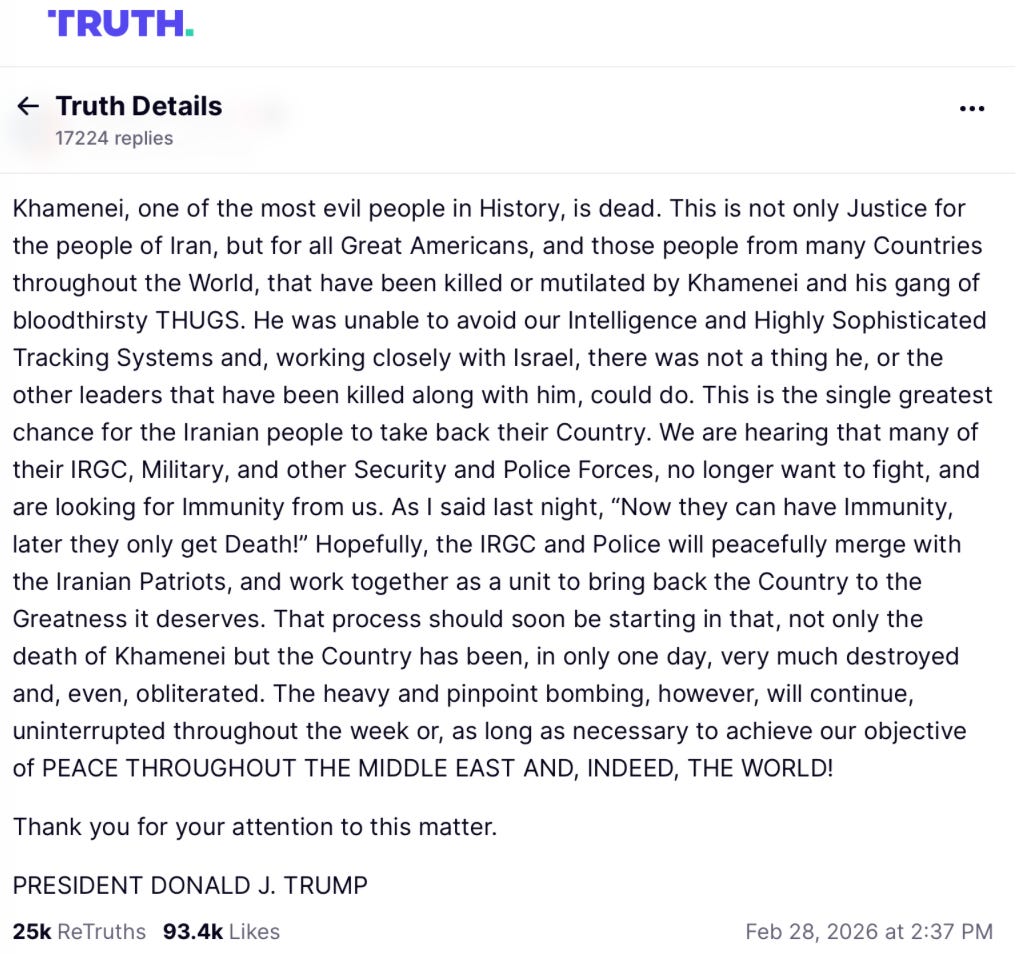
On the one hand, cutting off the head of terrorism, if that’s an accurate way to describe the Islamic Republic of Iran, might lead to the peace Trump wrote about, although his geographical ambitions for peace “throughout the world” seem wholly unrealistic. No matter the outcome with Iran, it won’t help Ukraine, it won’t help the Rohingya in Myanmar, it won’t help the beleaguered minorities in Sudan, it won’t help the Uyghur muslims in China.
On the other hand, while Iran has taken a bullet to the head, it’s still standing. And fighting. Its missile attacks against at least eight Gulf neighbors have killed a handful of civilians and have hit some tactical targets, including a few major airports, but they haven’t taken any of Iran’s Arab adversaries to the ground. Today they did strike a fatal blow in a city near Jerusalem, killing at least nine Israelis. And in the first report about American casualties, the Pentagon announced Sunday morning that three U.S. service members have been killed and more injured. That doesn’t compare in scale to the hundreds of deaths yesterday and today in Iran— including what appears to be the accidental destruction of a girls’ elementary school in southern Iran where more than a hundred little girls were killed.
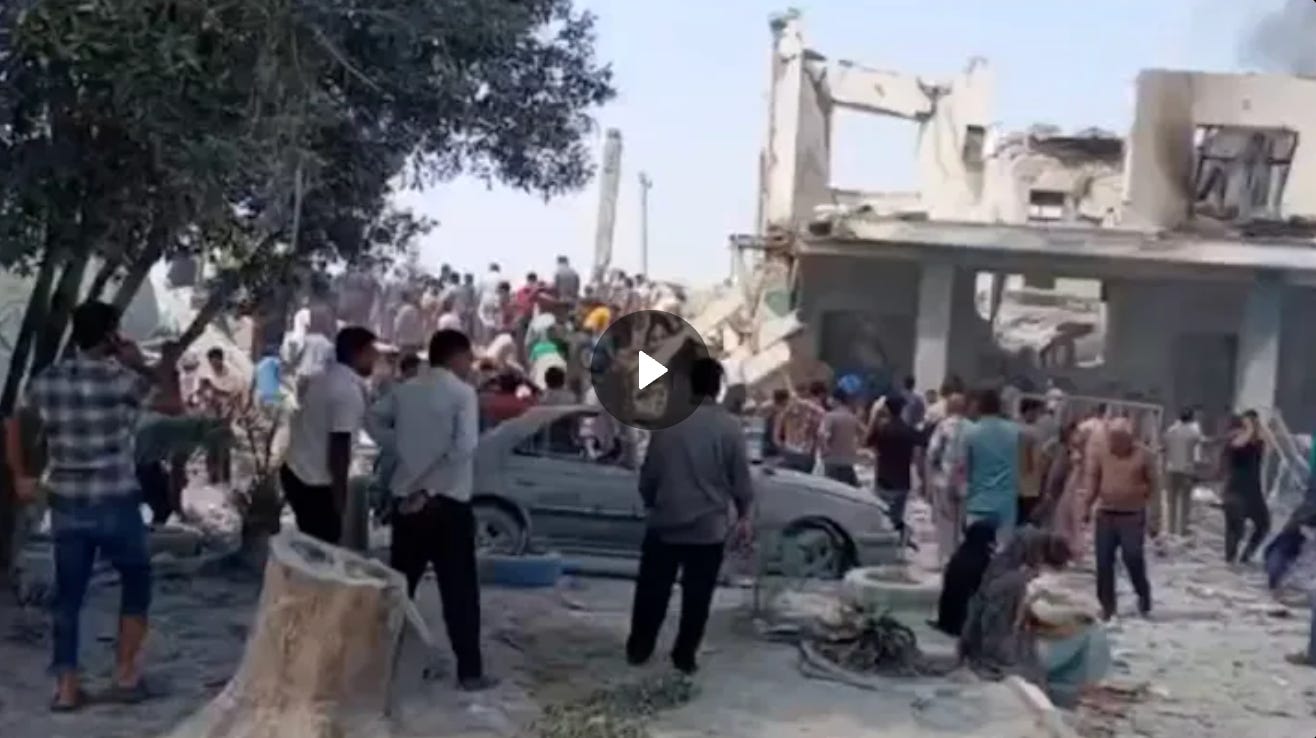
But here too, war is not measured by comparisons. If both sides are taking a toll on their enemies, however uneven the outcomes, it is war.
The trouble today— roughly a day-and-a-half after the first strikes Saturday— is that all we really know, thanks to public reporting by our news media, not by our government, is what’s been hit and who’s been killed. Beyond that, the White House and the Pentagon have told us next to nothing. The president spoke in a video released Saturday in the middle of the night and said, “Our objective is to defend the American people by eliminating imminent threats from the Iranian regime.” Then he told The Washington Post, referring to the Iranian population, “All I want is freedom for the people.” But only four nights earlier, in his State of the Union, in what amounted to only a couple of minutes on Iran, Trump focused only on its nuclear program— which he had declared “obliterated” only half a year ago.
So it’s fair to say, we still don’t really know why we’re at war. As Dan Rather wrote, there was “no congressional approval. No appeal to the American people. No explanation.” Rather rightfully said that it is our patriotic duty to support our troops. But “it is also patriotic to question those in power. Why are we at war? Why now? What does victory look like? How will we know we have won, if we do? What is the exit strategy? Is there an endgame?”
And finally, when will each side muzzle its weapons? Maybe once the U.S. and Israel have completed their military objectives, they will. But Iran? Their bark usually has been worse than their bite, but Iran’s president, who was not taken out in the initial strikes, vowed today that “bloodshed and revenge” are his nation’s “legitimate right and duty.” In what nations, in what form, with what effectiveness? Those are questions nobody can answer yet.
As for the people of Iran, Trump’s message to them in his Saturday night video was, “When we are finished, take over your government. It will be yours to take. This will be probably your only chance for generations.” But it probably is beyond the capacity of even the all-powerful United States of America to give them much more help making that happen. Which leaves yet another question: And then what?
So yes, we are at war. And no matter how confident Donald Trump sounds, it might be a state of war that lasts well into the future.
Over more than five decades Greg Dobbs has been a correspondent for two television networks including ABC News, a political columnist for The Denver Post and syndicated columnist for Scripps newspapers, a moderator on Rocky Mountain PBS, and author of two books, including one about the life of a foreign correspondent called “Life in the Wrong Lane.” He also co-authored a book about the seminal year for baby boomers, called “1969: Are You Still Listening?” He has covered presidencies, politics, and the U.S. space program at home, and wars, natural disasters, and other crises around the globe, from Afghanistan to South Africa, from Iran to Egypt, from the Soviet Union to Saudi Arabia, from Nicaragua to Namibia, from Vietnam to Venezuela, from Libya to Liberia, from Panama to Poland. Dobbs has won three Emmys, the Distinguished Service Award from the Society of Professional Journalists, and as a 39-year resident of Colorado, a place in the Denver Press Club Hall of Fame. He also has been a consultant for the Counterterrorism Education Learning Lab.
You can learn more at GregDobbs.net
You make a lot of sense.
Ts maniacal quest to win the Nobel Peace Prize aggravates his already ignorant and dim-witted war games with no experienced advisors in sight… God help us all!